Office Clearance in Ealing

Office Clearance Ealing provides a practical, carefully organised service for workplaces that need desks, chairs, filing, IT peripherals, storage items and general office contents removed with as little disruption as possible. Whether you are reducing floor space, emptying a single suite, or preparing for a change of tenancy, the work is approached as a structured clearance rather than a rushed collection. That means items are assessed, separated where needed and moved out in a way that helps you keep control of what stays, what goes and what should be handled separately.
We support offices of different sizes, from compact studios and shared work areas to larger commercial premises with more varied contents. The service can include the removal of redundant furniture, boxed materials, broken equipment and bulky items that are awkward to move without proper planning. In a busy workplace, a clear method matters: access routes, lift use, building rules and the sequence of removal all affect how smoothly the clearance runs. Our aim is to make the process straightforward while keeping the work aligned with the property and the items involved.
If you are planning an office move, refurbishment or downsizing project, start by identifying the main groups of items that need attention. A short list of what should be cleared, retained or separated for specialist handling can make the next step much simpler. When you are ready, you can request a quotation in the form that suits you best and share the scope of the work you have in mind.
Commercial office clearance and internal strip-out support
Many office clearances involve more than carrying furniture to a vehicle. Workplaces often contain mixed contents that need a sensible order of removal, especially where meeting rooms, storage areas, kitchen points and archive spaces are involved. We can clear standard office furniture, loose items, document storage furniture and general equipment in a way that helps keep circulation routes open and the premises manageable while the work progresses. This is useful when the property still has staff on site or when the timetable is tight.
The service can also be arranged around the practical sequence of a move-out. For example, some items may need to stay in place until a final equipment check, while others can be removed earlier so that rooms are ready for contractors or handover. A well-planned office clearance also needs to respect building arrangements such as loading access, shared entrances and time windows. If you have photographs or a simple room-by-room list, that can help shape a more accurate quotation and reduce uncertainty at the planning stage. It is often easier to quote when the main categories are clear.
What is commonly included
- Desks, workstations and office chairs
- Meeting tables, cabinets and shelving
- Reception furniture and storage units
- General office items and mixed contents
- Selected loose equipment for removal
Furniture removal for offices and workplaces
Office furniture is often the most visible part of a clearance, but it is not always the simplest. Large desks, modular storage and heavier cabinets can be awkward to shift through narrow corridors or around fitted fixtures. We remove office furniture with attention to access, handling and the condition of the surrounding space, so that the removal process remains controlled. If a room contains a mixture of reusable pieces and items that are no longer needed, the work can be organised to separate those groups before anything is moved away.
Furniture removal can be useful on its own or as part of a wider office clearance. It may suit a business replacing furnishings, reconfiguring a floorplate or clearing a suite after a lease event. Some items may be suitable for reuse elsewhere, while others may be beyond practical use and ready for disposal. Where relevant, the removal plan can account for stairs, lifts, communal areas and the order in which items should leave the building. That kind of preparation helps keep the job efficient without making assumptions about the layout or contents.
Furniture decisions that matter
Before a clearance, it helps to decide which pieces are staying, which are leaving and whether any items need to be held back for another department or location. In many offices, the furniture list is easier to manage than the smaller loose contents, so we often focus on the large and obstructive pieces first. Clear decisions about the larger items tend to make the whole job easier to organise.
Equipment, files and sensitive contents
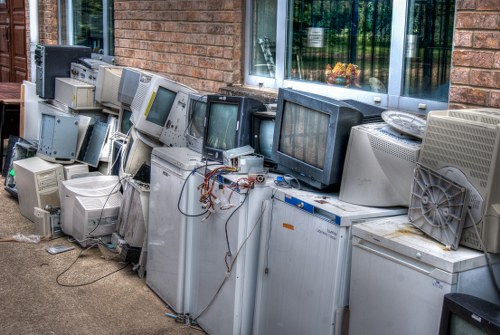
Office spaces frequently include more than furniture. They may contain old monitors, printers, ancillary devices, archived paper, boxed records and other mixed materials that require a measured approach. We can clear general office contents and keep the work organised around the items that need particular care. Where records, paperwork or equipment are involved, the important point is not to treat everything as a single pile. A proper clearance considers how items are grouped, handled and moved, especially when the premises contain a mix of everyday contents and items that should be separated before removal.
If you are planning a departure from an office, it is useful to think in categories rather than individual objects alone. Hardware, archive materials, storage boxes and general loose items may each follow a different path through the clearance. That does not make the service complicated for you; it simply means the work is best arranged with some detail at the start. A clear inventory, even if brief, can help us understand the scope and the likely access requirements. It also supports a more accurate quotation when there are multiple types of contents to remove.
For many customers, the most helpful next step is to group items by room or function before asking for a price. That approach keeps the enquiry practical and makes it easier to discuss what should happen to the contents that remain on site. If the office includes items that are not suitable for standard clearance, those can be identified separately so the right plan is used from the outset.
Planning the clearance around your premises

An office clearance is usually smoother when the access plan is considered alongside the items themselves. Shared entrances, security systems, parking arrangements and working hours can all influence how the job is carried out. We take a practical view of these details because even a straightforward clearance can become awkward if the route out of the building is not checked in advance. Planning is especially useful when there are several rooms to clear or when the building remains partially occupied.
Useful information to have ready includes the approximate number of rooms, the type of furniture present, any heavy items, and whether the clearance will be completed in stages. If you can describe how the office is used, that can also help to identify the right order for removal. A quick note about lifts, stairs or shared corridors is often enough to shape the work sensibly. Simple, specific details usually produce a more useful quotation than a long general message.
When the premises are still in use, we can work around business operations where that is practical. That may mean starting with storage rooms, removing unused furniture first or focusing on one side of the property before another. These decisions are made to support a tidy, efficient clearance rather than to create disruption. The intention is to leave the office easier to manage at each stage, not merely empty at the end.
Office furniture types and room-by-room clearances
Different office rooms tend to produce different clearance needs. A reception area may contain counters, display items and waiting furniture, while a meeting room often holds tables, stacked chairs and storage units. Workstations create a different pattern again, with desks, task chairs, cable accessories and personal items that must be dealt with in a sensible order. A room-by-room approach is often the cleanest way to manage an office clearance because it makes the space easier to understand and prevents useful items from being mixed up with general waste.
We can plan around individual rooms or around whole zones, depending on how the property is arranged. That may be useful for offices with several tenants, multi-room suites or businesses that want one area cleared before another. The benefit of this method is that it supports better control over movement, sorting and loading. It can also help when there are items that should not leave the site until a manager has reviewed them. The more clearly the rooms are identified, the easier it is to create a working plan.
For customers who want a more structured clearance, it can help to mark which rooms contain furniture only, which contain mixed contents and which contain archive or equipment storage. That small amount of preparation often improves the accuracy of the quote and makes it simpler to compare the scale of the work across different areas of the premises.
About Ealing
Ealing is a large district in West London with a long-established character that combines suburban streets, commercial centres and notable open space. Historically part of Middlesex, it grew from a village into a substantial metropolitan district as transport links expanded during the nineteenth and twentieth centuries. The area is now known for a mix of Victorian and Edwardian housing, civic buildings and modern retail and transport facilities, with Ealing Broadway acting as one of its best-known focal points. The district’s rail and Underground connections have long shaped its development, making it a place where local shopping, commuting and residential life sit closely together. Ealing Common and Walpole Park are among the open spaces that give the district a green balance, while Pitzhanger Manor and Gallery reflects the area’s architectural and cultural heritage. The town centre also retains a strong sense of local identity through independent businesses, places of worship, schools and community venues. Across the wider borough, different neighbourhoods contribute distinct streetscapes and historic patterns, from tree-lined conservation areas to more commercial thoroughfares. Ealing’s physical character is therefore a blend of transport accessibility, older suburban layout and changing modern uses, with civic and cultural landmarks sitting alongside everyday residential and retail activity. That combination has made it one of west London’s most recognisable districts, with a built environment that still carries traces of its village origins as well as its later growth into an urban centre.
Clearance for offices at different stages of change

Office clearance needs vary according to why the work is being done. A business may be preparing for a move, reducing unused space, handing back a lease or replacing older furnishings as part of a broader update. Each of those situations needs a slightly different sequence. In a move-out, the clearance may need to follow the packing schedule. In a refurbishment, some rooms may need to be emptied while others remain partly operational. In a handover, the focus is often on leaving the property in a clean and workable state without unnecessary leftover contents.
That is why the service is best treated as a tailored removal rather than a one-size-fits-all task. Some customers only need bulky furniture removed, while others need a fuller clear-out of mixed office contents. In either case, the aim is to keep the job orderly and to avoid unnecessary handling of items that do not need to move. The most effective plan is usually the simplest one that still matches the building, the access and the contents involved. If the work needs to be split across more than one date, that can be discussed as part of the quotation.
A useful approach is to think about the office in stages: what must stay, what can go now and what can be reviewed later. That helps prevent rushed decisions and makes it easier to organise the premises before the clearance starts. If you already know the rough timing of the work, include that when you request your quote so the plan can reflect your schedule.
Recycling, reuse and item sorting
Not everything removed from an office should be treated in the same way. Furniture, metal items, mixed materials and general office contents can often be sorted differently depending on their condition and type. We focus on practical sorting so that the clearance is carried out in an organised manner. Items in usable condition may be separated from those that are no longer suitable for further use, while material streams that are naturally different are handled with that difference in mind. This helps make the work more deliberate and less wasteful than a simple bulk removal.
For many offices, the best way to approach sorting is to identify any items that are definitely staying, any items that should be checked separately and any items that can be cleared as part of the main job. That is particularly helpful where a workplace has mixed contents in storage rooms or behind desks. A sensible sorting approach also reduces confusion later in the process. If there are specialist items, it is better to mention them early so they can be considered properly rather than added at the last moment without context. Good sorting is part of good clearance.
- Reusable furniture and office units
- Metal shelving and storage items
- Mixed office contents needing separation
- Bulky pieces that need careful movement
- General items suited to organised removal
Getting a quotation for office clearance

To request a quotation, it usually helps to describe the premises, the main items to be removed and any access points that may affect the work. You do not need to create a perfect inventory before you enquire, but a clear summary is useful. A brief description of the office layout, the type of furniture involved and whether the clearance is for a full floor, suite or smaller workspace can make the discussion more efficient. If you have a target date, that can be included as well so the timing of the work can be considered alongside the scope.
Where a workplace contains both standard office contents and items that need separate handling, it is best to mention those differences at the same time. That helps the quotation reflect the job more accurately and avoids assumptions about what is included. If photographs are available, they can support the description, but they are not the only way to explain the work. A concise written summary is often enough to begin with. When you are ready, send the details and ask for a quote so the clearance can be shaped around your office rather than a generic checklist.
For a straightforward enquiry, you can also note whether you need a single-room clearance, a full office clearance or furniture-only removal. That small distinction often changes the scale of the job and helps ensure the proposal matches the work you actually need. If the premises include items to keep in place until the end, mention that too, and the plan can account for it from the outset.